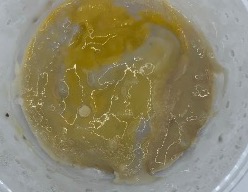
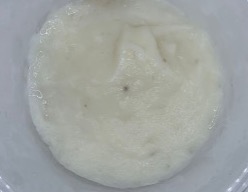
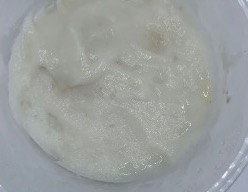
The untreated sample showed pronounced discoloration; 0.5% RC001 retained a pale appearance close to the SAPP benchmark.
Introduction
Refrigerated mashed potato progressively loses lightness during storage. Chemical preservatives such as sodium acid pyrophosphate (SAPP) chelate transition metals to limit after-cooking darkening, but manufacturers are increasingly seeking clean-label alternatives.
RC001 is a palm side-stream polyphenol ingredient produced from palm oil production palm press fiber using circular-economy-based green extraction and purification technology.
The key objectives of this study were to demonstrate the efficacy of RC001 in improving color and odor parameters over a 20-day preservation period, and compare performance to SAPP.
Methods
Experimental design
Mashed potatoes were made using fresh, boiled, homogenized potatoes with no additives. Study arms were: control; citric acid; SAPP 0.1%; RC001 0.5%, 1.0% and 1.5%; RC001 + citric acid.
Refrigerated stress screen
Samples were stored at 7–10°C in sealed containers for 20 days.
Observations
Measurements were taken on Days 0, 3, 7, 13 and 20.
Outcome measures
L*a*b* color, browning and odor scores, pH and moisture.
Day-20 lightness across all treatments
L* scale: higher values indicate a lighter sample
SAPP 0.1%69.91
RC001 0.5%69.37
Citric acid69.37
RC001 1.5%66.94
RC001 + CA65.36
RC001 1.0%62.8
Control32.32
RC001 0.5% SAPP benchmark Other treatments Untreated control
Conclusions
RC001 performs as well as SAPP
Similar appearance with the same odor and browning scores.
Minimal dosage requirements
Higher doses did not improve color retention and RC001 + citric acid did not appear to improve performance.
Strong basis for further studies
This screening justifies a replicated formulation study and possible line trials.
Why this matters
RC001 offers a low-dose, clean-label preservation system for potato products.
A circular-economy, green-technology product from a palm oil production side stream: non-chemical and price competitive.
References
Calder et al., J Food Sci. 2012;77:S342–S347. doi:10.1111/j.1750-3841.2012.02900.x
Mosneaguta et al., J Food Sci. 2012;77:C1234–C1240. doi:10.1111/j.1750-3841.2012.02957.x