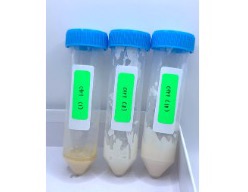
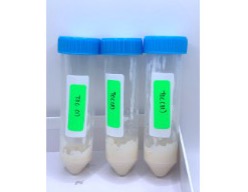
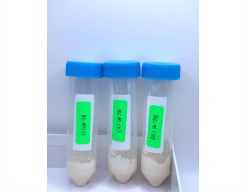
Day 21 photographs. RC001-OE and tocopherols retained odor scores of zero throughout storage.
Introduction
The preservation of oil-based foods such as mayonnaise is challenging, as it requires control of oxidation and odor, and the maintenance of emulsion stability.
RC001-OE incorporates palm press fiber polyphenols in an oil-emulsion ingredient. This ingredient valorizes a palm oil production side stream.
Objective: compare RC001-OE with mixed tocopherols and botanical preservatives in a 21-day accelerated mayonnaise storage screening trial.
Methods
Experimental design
Seven arms: control, vehicle, olive, green tea, rosemary, mixed tocopherols and RC001-OE.
Accelerated storage screen
Mayonnaise samples stored in an incubator at 40°C for 21 days.
Observations
Days 0, 3, 7, 14 and 21.
Outcome measures
p-anisidine value (secondary oil oxidation), odor and color, pH, separation and visible mold/gas.
Day-21 p-anisidine values
Means of 3 recorded measurements
Control2.57
Vehicle3.36
Olive3.37
Green tea5.33
Rosemary2.59
Tocopherols2.78
RC001-OE2.84
RC001-OE Mixed tocopherols benchmark Other treatments Untreated control
Conclusions
Tocopherol-like endpoint
RC001-OE showed a similar secondary oxidation product control profile to mixed tocopherols.
Odor and stability retained
RC001-OE performed well in terms of preventing unacceptable odors and oil-mayonnaise separation.
Promising preservative
RC001-OE performed better than olive and green tea extracts and only slightly worse than rosemary extract.
Next steps
Palm side-stream polyphenols merit further testing as an oil-based food preservation ingredient.
Larger-scale, independent testing is required, including commercial shelf-life and safety studies.
Potential in preservation of vegetable and animal oils to be explored.