Research
A Novel Upcycled Bioactive Natural Product Coating for Ultra-Processed Food Fortification
In collaboration with
Key Lipid Oxidation Results
RC003-coated chips showed 22% lower lipid oxidation after 6 days of accelerated storage at 40 °C.
p-Anisidine at Days 0, 4 and 6
- LNSC Flavored chips, control
- LNSE Flavored chips, RC003-coated
- STAXC Unflavored chips, control
- STAXE Unflavored chips, RC003-coated
p-AV values read from the poster chart (approximate). Higher values indicate more secondary lipid oxidation.
Show the values as a table
| Sample | Day 0 | Day 4 | Day 6 |
|---|---|---|---|
| LNSC Flavored chips, control | 0.4 | 1.2 | 0.5 |
| LNSE Flavored chips, RC003-coated | -0.1 | 1.1 | 1.1 |
| STAXC Unflavored chips, control | 1.9 | 4.8 | 2.3 |
| STAXE Unflavored chips, RC003-coated | 0.6 | 4 | 2.7 |
Major constituent groups on fortified chips
| Metabolomic components | Identified on coated chips | Fortification functionality |
|---|---|---|
| Simple sugars | Xylose, isomaltose, glucose | Antioxidant, antimicrobial |
| Phenolic compounds | Flavonoids, polyphenols | Antioxidant, beneficial bioactive molecules |
| Small peptides | Aromatic, His and leucine peptides | Antioxidant, beneficial bioactive molecules |
| Organic acids | Lactic acid | Antimicrobial, flavor stabilization |
| Osmolytes | Betaine and sorbitol | Protein metabolism support, food preservation |
The health challenge of ultra-processed foods
Ultra-processed foods (UPFs) constitute approximately 60% of dietary intake in many industrialized countries and are associated with obesity, chronic disease, reduced cognitive performance and shortened lifespan. UPF production strips grains, vegetables and fruit of the bioactive molecules contained in their skins and husks. These bioactive molecules have antioxidant, micronutrient replacement and gut microbiome functionality, thereby contributing to a health-promoting diet.
RC003 description, study objectives and methods
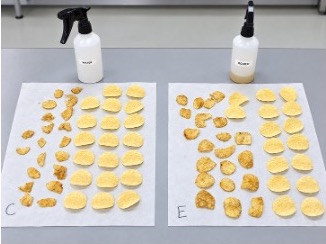
RC003 is an upcycled food ingredient (acidogenic fermented, natural deep eutectic solvent (NADES) extract of fruits, vegetables, rice bran and bakery side streams combined with a 10% (v/v) polyphenol extract from palm press fiber). RC003 was sprayed as a coating on commercial potato chips (flavored and unflavored) and compared with DI-water coated controls. To evaluate the transfer of natural functional metabolites from RC003 to ultra-processed potato chips, we performed metabolomic profiling and identified compounds with potential antioxidant, functional nutritional, antimicrobial and food-preservation properties.
Analysis
Metabolomic analysis: capillary electrophoresis–mass spectrometry (CE–MS) and liquid chromatography–mass spectrometry (LC–MS), with complementary extraction workflows for polar and lipid metabolites. Library-based annotation and targeted quantification were combined into a metabolite inventory. Secondary lipid oxidation product levels were estimated through p-anisidine measurement on Days 0, 4 and 6.
A promising UPF preservation and fortification ingredient.
RC003 functions as an upcycled coating that restores natural bioactive molecules and reduces lipid oxidation in a UPF model.
Future research
Long-term shelf life studies
Safety testing, organoleptic profile and consumer preference
Digestion studies for gut metabolite delivery
Human nutrition studies including metabolomic markers
Interested in RC003 for your food products?
Request information and samples